When you are out on safari, it is not uncommon to see vast numbers of wild animals, including huge herds of buffalo, zebra, wildebeest, giraffe and all kinds of antelopes. With an experienced guide, you even have a good chance of spotting some of the big cats, such as lions and cheetahs.
However, there is one particular animal in Africa which is very elusive and can be a real challenge for even the most experienced of guides to track: The Leopard.
Leopards are largely nocturnal creatures and usually spend their days resting high up on tree branches. Their camouflaged coats, dotted with rosettes, enable them to blend in seamlessly with the surrounding foliage. With such unique characteristics, most people find it very difficult to spot these exotic felines.
Fortunately, I had the privilege of spotting these beautiful cats several times during my game drives in Botswana. On one particular occasion, while we were casually driving back to camp, not expecting to see anything special, we came across a handsome looking male, purely by chance. Not to let this wonderful opportunity slip by, I grabbed my camera and began to click away.
So, the following day, I headed out for my second game drive in anticipation. I was not sure what to expect, as the wilderness can be so unpredictable. The more ‘glamorous’ animals often do not show up when you want them to. In fact, there are times when you can be driving around the savannah for hours, searching for interesting sights, only to be rewarded with a mere glimpse of a scrub hare.
Personally, I am not overly concerned as my priorities are a bit different. I just love the feeling of being out in the bush, experiencing a sense of freedom in the vast openness of the African plains. These simple desires are enough to captivate me and to take my breath away.
We boarded our small boat and headed back to the jetty where our vehicle was waiting. As we cruised along the peaceful channel, I dipped my fingers into the water and thought to myself, “The Okavango Delta. Such a magical place!”
A few minutes later, we arrived at the jetty. With the help of Bill and Sevara, my camera equipment was carefully loaded into the vehicle. Once we had settled down comfortably, Severa started the engine and soon we were off for another new adventure.
The ride was bumpy as we drove across the rough African terrain. Our poor backs and buttocks were sore, but none of this mattered.
I began to survey every inch of the plains meticulously, hoping to spot a cheetah weaving its way through the tall grass. It was not an easy task as my eyes are not trained to spot camouflaged wildlife.
I was just about to give up when Severa, with his experienced ‘bush-eyes’, managed to spot a coalition of male lions in the far distance. Excited and happy with our new discovery, we quickly and discreetly made our way towards the big cats.
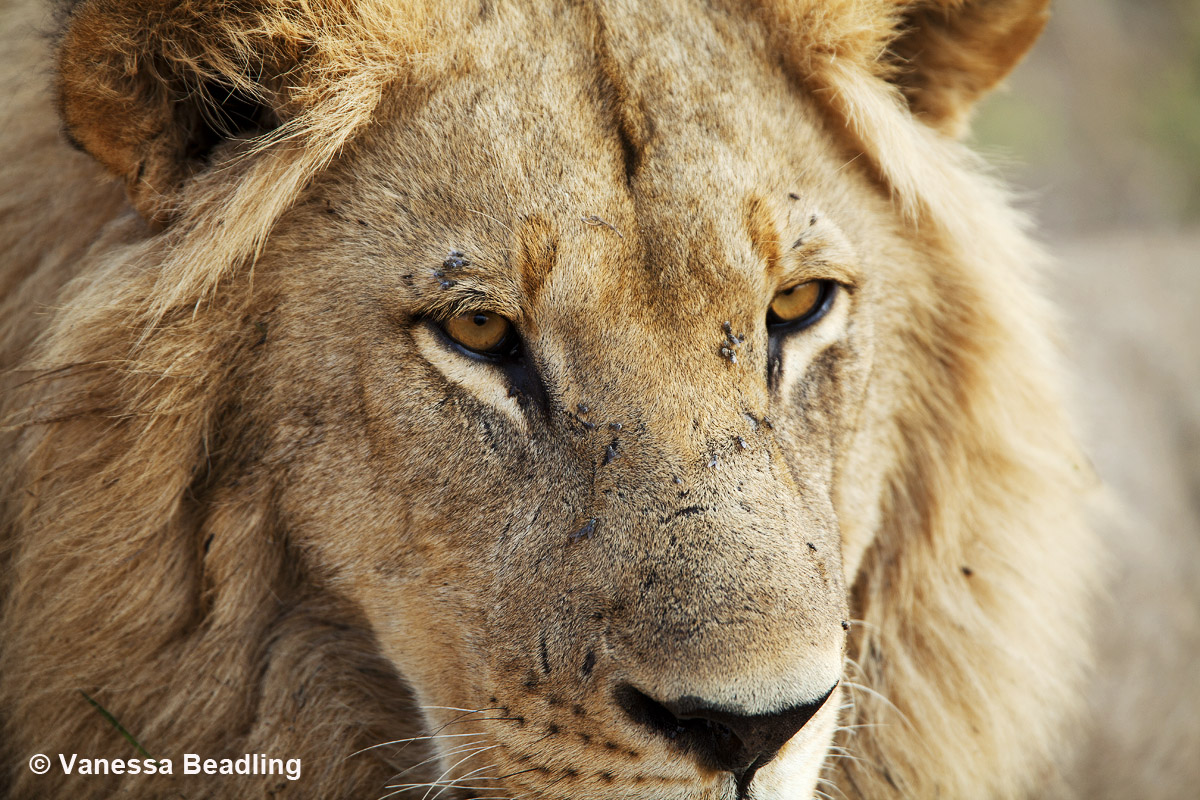
We counted four massive male lions lolling around by the bushes. They basked under the sun without a care in the world, unperturbed by our presence as we approached them.
One of them was sprawled on the ground, unashamedly baring his underside. Another let out a huge yawn, exposing his fearsome canines. Their broad muzzles were covered with old battle scars, possibly inflicted by their enemies during fights over a kill, a territory or a mate.
As we looked on, the largest of the lions, got up and exposed his muscular, tawny body. He shook his huge dark mane and looked around his ‘kingdom’. Without any warning, he let out a huge deafening roar, as if to say, “Whose land is this? Whose land is this? It is mine! It is mine! It is MINE!”
It was an intimidating moment, knowing that a swipe from one of those mighty paws could easily kill me. Being next to the ‘king of the beasts’ made me feel so small and insignificant.
As I regained my composure, I picked up my camera, pointed it at the dark-maned lion and began to click away furiously. Sensing that his picture was being taken, he looked into my camera and began to strike some poses. To have such a strong and beautiful subject as a model would be any photographer’s dream come true. Here he was, right in front of me. He was simply perfect!
As we sat there for the next couple of hours, I began to feel a sense of sadness that these majestic cats are being driven to the brink of extinction. Over the past two decades, the lion population has been decreasing drastically. One of the reasons for such a huge decline is that they are often hunted as trophies. I find this ‘sport’ extremely distasteful. I just cannot understand how anyone could feel the urge to shoot such a magnificent animal?
The thought of there being no lions roaming the African plains is enough to break my heart. I put my camera away, sat back and simply enjoyed the company of these beautiful creatures.
Following our wonderful stay in Kwando, it was time for us to move on to our next camp. Before I boarded the charter plane, I took one last look at the Linyanti reserve and said to myself, “I’ll definitely return here someday.”
We were to spend the next few days at Vumbura concession, which is located at the northern edge of the Okavango Delta. The ‘Delta’, often referred to as the ‘Jewel of the Kalahari’, is a huge inland floodplain. It is created as the annual rains falling in the Angolan highlands flow into the panhandle of the Okavango river, which then fans out into an enormous delta; never reaching the sea.
The flight from Kwando to Vumbura was short. Upon arrival at the airstrip, we were greeted by our guide who warmly introduced himself as Sevara. He drove us a few miles to a small jetty, overhanging the Delta. From there, we had to take a boat ride in order to reach our camp.
The channel banks were covered with papyrus plants and reed rafts. Sevara gave me a chilling reminder of how this innocent looking vegetation, floating above the sand bed, was a perfect hiding place for the local crocodiles!
As the boat cruised along the channels, I dipped my finger into the water and said to Bill, “I can’t believe it. We’re actually cruising on the Okavango Delta!” For me, this was a dream come true!
The path leading to our camp.
Once we reached the camp, we quickly dropped our bags, grabbed our essentials and headed straight out to the bush. My camera was on standby and I was ready for another adventure. As we began the game drive, I wondered to myself, “What does Africa have in store for me today?”
We were sharing our vehicle with an elderly English couple. The nice lady leaned over and whispered to me, “Sevara is brilliant at tracking wild dogs. We have had some amazing sightings.”
She was right. Sevara certainly did not disappoint us. Within twenty minutes, he had managed to track down a pack of dogs. There they were, resting under the shade of the bushes, taking their afternoon siesta.
As we drove towards them, one of the dogs must have sensed our presence and looked up. Although I couldn’t see its face clearly, I could trace the silhouette of its head with its big round ears; alert like huge satellite dishes.
The African wild dog is an endangered species. Several decades ago, there were upwards of half a million of them roaming through the vast plains of Africa. Nowadays, their numbers have dwindled to fewer than 5,000. Loss of habitat, competition with larger predators for food and epidemic diseases are just a few of the causes for such a drastic decline in their population.
An African wild dog, Lycaon Pictus. They face an uncertain future.
The pack must have numbered around forty dogs, half of which were puppies. Thrilled at discovering such a large pack, we decided to spend the rest of the afternoon with them. Although they were relatively inactive, even the occasional flick of a tail or twitch of an ear was enough to set my heart thumping with excitement.
Eventually, a lone male began to stir from his deep slumber. He let out a huge yawn, stretched himself and trotted over to the rest of the pack members to greet them.
Pretty soon, they were all nuzzling each other and twittering incessantly. This peculiar greeting ritual is a kick-start to their pre-hunt preparations.
They were excited and ready for the off.
Awake and hungry.
We followed them as they commenced their hunt.
African wild dogs typically hunt twice a day; early in the morning and before sunset. They are formidable predators, even taking down large animals such as Eland. Built for endurance, they are able to chase their prey relentlessly over long distances. Once they have singled out their ‘target’, there is little or no escape; with around 85% of hunts ending in success.
One of the dogs let out an alarm bark. Within seconds, the chase began. Sevara shouted, “Hang on tight!” He started the engine and we took off after the dogs.
We followed them through open plains and thick woodlands. Though we had no idea what they were after, we were just exhilarated to be part of the chase.
After a few minutes, we caught up with the pack leaders and were greeted by the most extraordinary scene. The dogs were surrounding a tree, baying and causing a general ruckus. I grabbed my binoculars to check out what all of the commotion was about. There it was, a leopard at the top of the tree seeking protection from the menacing dogs! They had seemingly flushed out their fellow predator and pursued it to its precarious position.
Can you spot the leopard?
Realising that the skittish cat would not be coming down anytime soon, the dogs gave up on the situation and decided to search for another 'victim' while there was still enough light to hunt. Once the coast was clear, the leopard scampered down from the tree and disappeared into the thickets.
“That was certainly a lot of excitement!” I thought to myself. However, I did not realise that there was more to come.
Having located the dogs once more, we continued to track them closely. The atmosphere was peaceful - for a while. Suddenly, all hell broke loose. The dogs went into hot pursuit again. This time they were after a spotted hyena.
The poor hyena was running for its dear life.
Once again, Severa shouted to us, “Hang on tight!” This time he meant it. We sped through the shallow waters of the floodplain like a torpedo. The spray was billowing out from either side of the vehicle as we hurtled after the chase.
I had one hand clutched tightly onto my camera and the other onto the vehicle as I hung on for dear life. My adrenalin was pumping. I took a quick glance at Bill. He seemed oblivious to the bumpy ride; too engrossed in the moment.
The dogs soon caught up with the hyena and surrounded it.
Over the course of the next few minutes, they attacked the hyena relentlessly from all directions; snapping and nipping incessantly at its bloodied body.
The hyena mustered all of its strength to defend itself from the vicious pack. Somehow it eventually managed to escape from the dogs’ clutches and made a mad dash towards the woodlands.
Its fate was not yet over as the dogs continued to pursue it. We managed to capture some of the action on video.
I asked Severa, why would the dogs be chasing leopards and hyenas? He explained how predators, such as lions, leopards, hyenas and the dogs themselves, all compete with each other for food. Given the opportunity, any one of these animals would not hesitate to kill their rivals in order to eliminate competition.
By this time, it was getting too dark for the dogs to continue hunting. We watched as they decided to call it a day and retreat back to their den with empty stomachs. The day did not belong to them. The puppies would go hungry for the night.
For our part, we marvelled at what we had witnessed during the day. It dawned on me that wildlife professionals often take weeks or months to document such sightings. We had been privileged enough to experience them during our first day in the Okavango Delta. I said to myself, “What more could I ask for?”